What this investigation found
Huntington City Council voted 6–4 to authorize two resolutions covering license-plate readers, live video cameras, drones, gunshot detection, software, and support. The public vote was visible. The months of vendor and police work that produced the package were not fully visible in the reviewed record.
The filed order forms describe an integrated surveillance platform rather than a limited roadside-camera purchase. Council rejected a requested two-week postponement after an overnight meeting, but officials acknowledged more than six weeks later that the contract was still unfinished and no payment had been made. That mismatch does not prove corruption. It creates a material question about the claimed urgency and the process that preceded public review.
The record supports serious transparency, civil-liberties, procurement, and institutional-influence concerns. It does not currently establish bribery, kickbacks, bid rigging, or personal enrichment.
What Huntington authorized
The proposed package includes more than license-plate readers:
- 46 automated license-plate reader systems
- 17 pan-tilt-zoom live video cameras
- Two Drone as First Responder systems
- Two quarter-mile gunshot-detection coverage areas
- Flock 911 for Aerodome, Flock OS 360, and premier support
The two authorizations state a combined commitment of $2,225,225 before renewal. Contract exhibits also contain a perpetual data license, automatic-renewal exposure, unfinished Flock OS 360 product language, and GovWorx terms without a clear public explanation of GovWorx’s operational role.
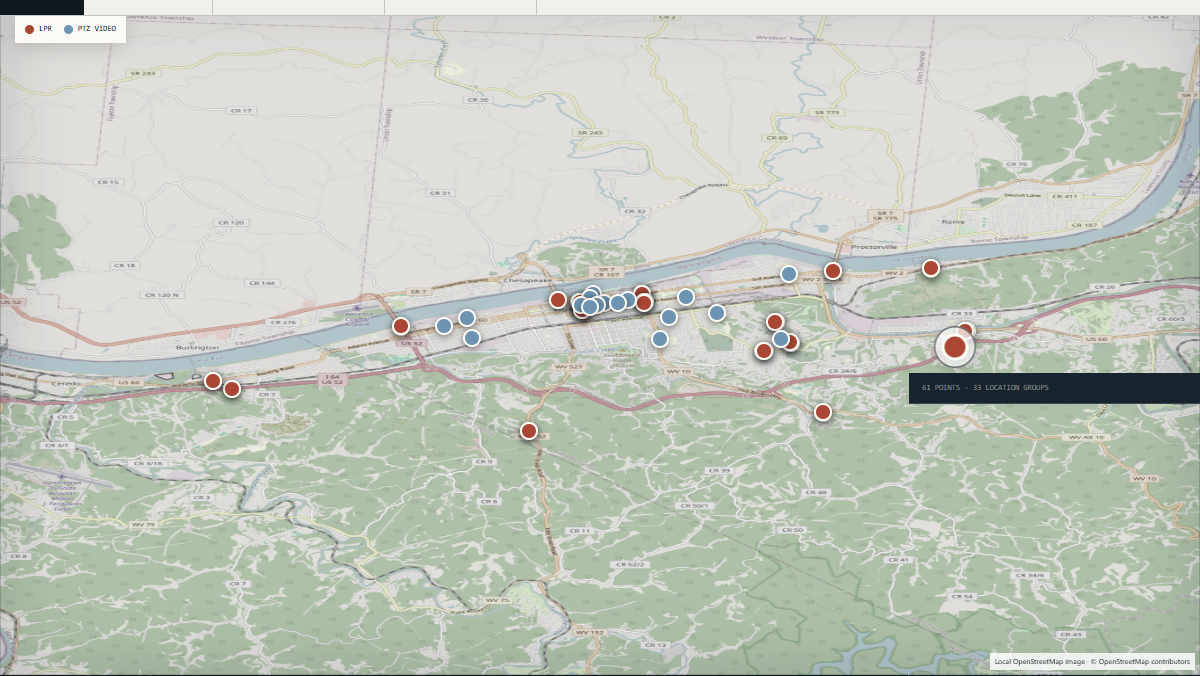
Proposed Huntington Flock camera map
The released “Final Locations” layer contains 61 fixed positions: 44 license-plate-reader points and 17 PTZ video points. The equipment package lists 46 plate readers, leaving two approved LPR placements unaccounted for in the released layer. The map documents proposed positions, not verified live installations.
Why residents opposed the proposal
More than 50 residents spoke during the July council meeting, and contemporaneous reporting described the opposition as overwhelming. Residents raised concerns about mass location tracking, data sharing, wrongful police encounters, vendor access, procurement, and the timing of enforceable safeguards. A later citizen initiative sought to prohibit third-party mass-surveillance systems.
PublicRot’s disclosed editorial position is that government should investigate suspected wrongdoing rather than create a searchable movement history for everyone and decide later whose life to inspect. That position does not replace evidence: claims, documented events, allegations, court outcomes, and unanswered questions remain separately labeled.
Documented Flock failures elsewhere
PublicRot’s national archive groups 157 Flock-linked incidents traced to reporting, official investigations, court records, audits, or a source index leading to the underlying record. These cases document recurring failure modes—not a national error rate.
The archive includes authorized-user misuse for personal tracking, camera misreads, stale hotlists, incorrect data entry, poor verification, access beyond locally understood boundaries, and vendor or contractor access. Allegations are labeled, and grouped personnel audits are not inflated into multiple headline incidents.
Questions Huntington still needs to answer
- Who initiated the project, and when did the first city–vendor contact occur?
- What competing products, prices, and procurement routes were evaluated?
- Why was a two-week delay unacceptable if the agreement remained unfinished weeks later?
- Which final terms control retention, outside-agency searches, vendor access, auditing, and renewal?
- What is GovWorx’s role, and which Huntington data could it receive or derive?
- Where are the two approved LPR positions missing from the released map?
Key sources
The interactive case file contains 49 linked sources and a complete evidence register. Core sources include:
- E001Filed petition, Resolutions 89 and 90, and contract exhibits
- E002West Virginia Watch report on the council vote and public opposition
- E003WSAZ report on the proposed package and map
- E005ACLU of West Virginia lawsuit announcement and filing link
- E007West Virginia Public Broadcasting report on the overnight meeting
- E011Contract-status report and ballot-initiative coverage
- N001Institute for Justice ALPR abuse and error source index
- N019Associated Press investigation of Border Patrol access to Flock data
Interactive investigation
Examine the record yourself.
Search every documented incident, inspect the proposed camera map, open contract issues, trace decision channels, review subject files, and work through the evidence chapter by chapter.
Open the full interactive case →